
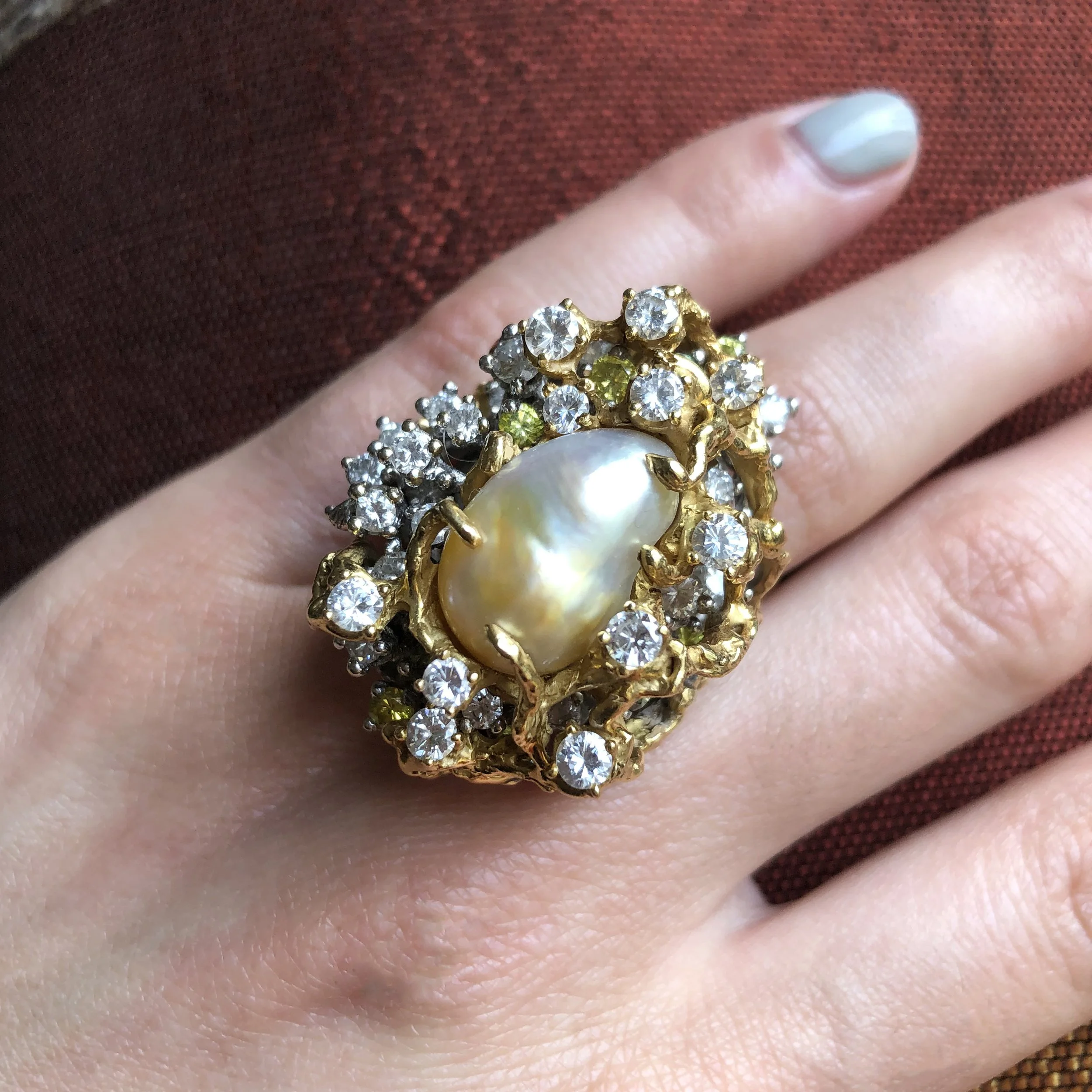
ARTHUR KING (1921-1986)
Arthur King was a pioneering American studio jeweler and master goldsmith renowned for his unconventional, organic designs that helped define modernist jewelry in the mid-20th century. Born in New Jersey in 1921, he developed an early interest in art and metalwork and served in the Merchant Marines during World War II, where he began experimenting with jewelry using scrap metal and found objects. His early work often incorporated unusual materials such as sharks’ teeth and rough stones, reflecting a freeform sensibility that would become his signature.
After the war, King returned to New York City and opened his first workshop in Greenwich Village in the late 1940s and 1950s, alongside his contemporaries like Sam Kramer and Art Smith, where he initially worked in brass and silver before transitioning into gold. He taught himself lost-wax casting (while recovering from a wartime injury) a technique that enabled him to create highly sculptural, one-of-a-kind pieces with textured metal and raw or uniquely cut gemstones. His work stood in stark contrast to the polished symmetry popularized by traditional jewelry houses, instead embracing asymmetry, organic forms, and the expressive potential of the materials. He especially favored baroque pearls, often designing a setting around their unusual shape, which would enhance the beauty of the gemstone.
King’s reputation grew quickly, and in 1961 his work was included in the International Exhibition of Modern Jewellery at Goldsmiths’ Hall in London, affirming his status on the international stage. He soon opened multiple boutiques — at one point as many as eighteen — in major cities including New York, London, Miami, Paris, Havana, and Cape Cod, establishing a global presence for his brand, which was forward thinking for the time.
His store in NYC was located at 611 Madison Avenue and stood out for its wood and cork design. King’s jewelry was carried by prestigious retailers, including Fortum and Mason in London, and worn by celebrity clients, like Elizabeth Taylor, Lena Horne (who lent him money to open one of his stores), Vidal Sassoon, Clare Booth Luce, and many others.
He continued designing and producing jewelry through the 1960s and 1970s, leaving a legacy as an influential figure in American jewelry design. He passed away in 1991. Arthur King’s jewelry can be found in prominent private and public collections including the Victoria and Albert Museum in London and the Cincinnati Art Museum.
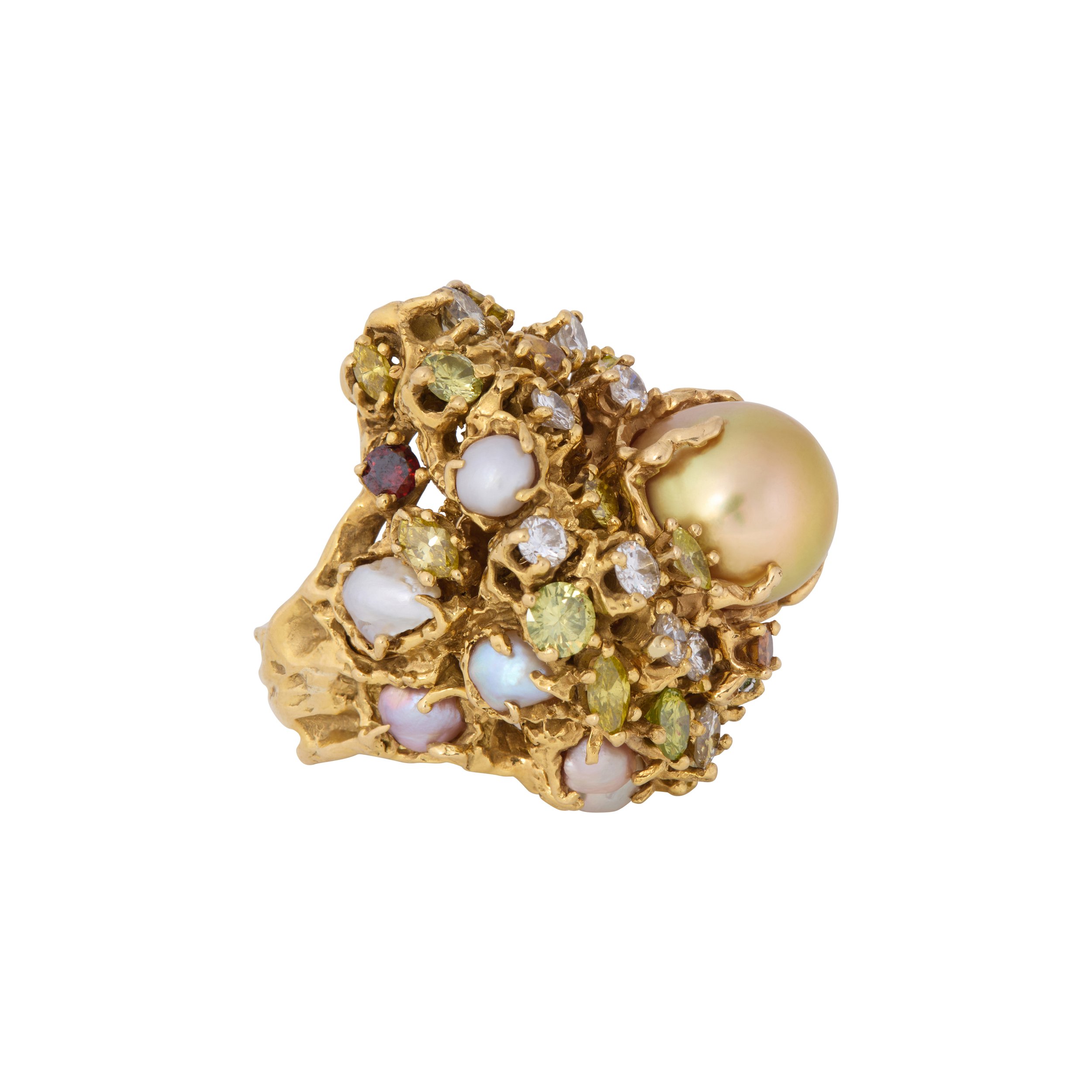

Description: A pair of emerald, pearl, diamond, and 18 karat yellow gold earrings by Arthur King, USA, c. 1965.
Marks: AK, 18K, assay marks, 18, 750.
Dimensions: 0.92” x 0.92”.
Weight: 17.65 grams.
<inquire>